
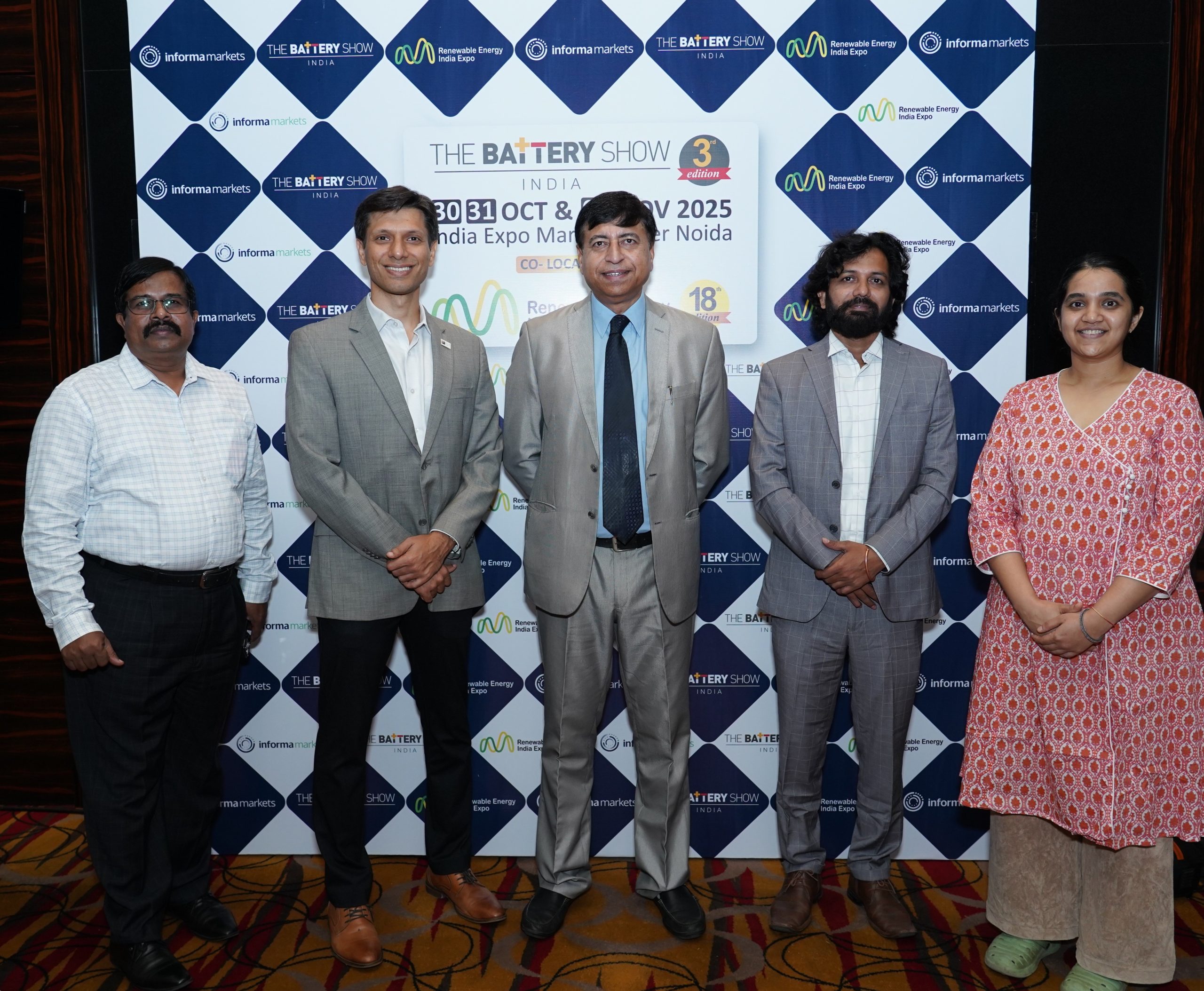
Industry Leaders Converge in Pune ahead of The Battery Show India to discuss the future of Clean Energy

Pune Roundtable Highlights India’s EV Market Growth from 99,000 Units in 2024 to 700,000 by 2030”
Pune: Informa Markets in India, the country’s leading exhibition organiser, is set to host the 3rd edition of The Battery Show India (TBSI) 2025 alongside Renewable Energy India (REI) from October 30th to November 1st, 2025, at the India Expo Centre & Mart (IEML), Greater Noida. Serving as a pivotal platform for the rapidly expanding Indian electric vehicle (EV) and energy storage market, the event comes at a time when the global shift towards electric mobility is opening new avenues for automotive suppliers and technology innovators. The Indian EV battery market is projected to grow from USD 16.77 billion in 2023 to USD 27.70 billion by 2028, highlighting the immense potential for investment, collaboration, and technological advancement across the value chain.
As a preview to The Battery Show India, an Industry Roundtable was held in Pune on October 15th at the JW Marriott, bringing together key stakeholders from the energy storage and electric mobility ecosystem to deliberate on the sector’s growth trajectory, technological advancements, and emerging opportunities. The roundtable featured participation from distinguished industry leaders, including Mr. Prajyot Sathe, Head of Electric Vehicles Research, Frost & Sullivan; Mr. Ramnik Singh, Country Head, India, GammaTechnologies; Ms. Apoorva Bedekar, Chief Operating Officer, Cordwood Technologies LLP; Mr. Kapil Baidya, Vice-President, Energy in Motion and Mr. Rajneesh Khattar, Senior Group Director, Informa Markets in India, driving India’s clean energy transition.
As India moves rapidly towards sustainable mobility, Pune, home to major automotive OEMs, battery manufacturers, and R&D hubs plays a pivotal role in advancing next-generation battery technologies and strengthening the country’s position as a global hub for electric mobility innovation.
Mr. Prajyot Sathe, Research Director, Mobility – Electric Vehicles, Frost & Sullivan said “The global electric passenger car market is evolving rapidly and is expected to reach around 21 million units by the end of 2025. Within this, battery electric vehicles (BEVs) currently account for 60–70% of the market, while plug-in hybrid and extended-range electric vehicles make up the remaining 30–35%, reflecting a recent rise in hybrid adoption. In comparison, India’s passenger EV market closed at nearly 99,000 units in 2024 and is projected by Frost & Sullivan to reach approximately 140,000 units in 2025, with 99.9% being pure battery electric vehicles, as plug-in hybrids are yet to establish a significant foothold. Looking ahead, the Indian market is expected to grow to about 700,000 units by 2030, representing 7–8% penetration of total passenger vehicle sales.
This growth trajectory is being fuelled by supply chain localization, cross-industry collaborations, and rapid technological advancements. While Tata Motors and Mahindra & Mahindra are expected to emerge as key leaders in the battery-electric segment, Maruti Suzuki is likely to focus on hybrid technologies. Additionally, new entrants such as Tesla and VinFast are anticipated to strengthen the premium EV segment, though mass-market electric vehicles will continue to drive mainstream adoption. As the industrymatures, India’s ecosystem is moving toward a more localized, technologically advanced, and strategically collaborative electric mobility landscape.”
Mr. Ramnik Singh, Director – India & ASEAN, Gamma Technologies said, “Electrification has been a major focus since 2018, with global targets initially set at 30% EV adoption by 2030. However, current projections now stand between 7% and 15% of total OEM sales, indicating a shift toward a technology-agnostic powertrain mix. The future will see a blend of electric, hybrid, and range-extended vehicles designed for efficiency, affordability, and reduced range anxiety.
At Gama Technologies, our CAE simulation solutions are built to support this evolving multi-powertrain landscape across industries. In India, government initiatives like FAME and PLI schemes have accelerated EV adoption and localized cell manufacturing. The next critical step should focus on incentivizing battery recycling particularly for LFP batteries, where economic feasibility remains a challenge. As the industry advances, improvements in powertrain efficiency, thermal management, and passenger comfort will define the next generation of EVs and hybrids.”
Ms. Apoorva Bedekar, Chief Operating Officer, Cordwood Technologies LLP said “The growing demand for efficient Battery Management Systems (BMS) across electric vehicles and energy storage systems is driving innovation in India. While large-scale ESS solutions are still being imported in SKD formats from China, there is a strong push toward indigenizing technologies suited to Indian conditions. Strengthening local R&D, certification frameworks, and collaborations between OEMs and technology developers will be key to this transition. Building ‘India-first’ products leveraging domestic supply chains and resources will pave the way for greater self-reliance and technological maturity in the nation’s battery ecosystem.”
Mr. Kapil Baidya, Vice-President, Energy in Motion said “In India, LFP (Lithium Iron Phosphate) batteries are the preferred choice for EVs due to their safety and suitability for tropical conditions, while long-life cells are available at higher costs. Batteries reaching end-of-life in vehicles can be repurposed for 5–10 years in stationary energy storage before recycling. The government’s 2022 Battery Waste Management Regulations mandate BIS-certified imports and enforce recycling guarantees, reducing safety incidents. With 10–15 Indian companies now active in cell recycling and new subsidies for electric trucks, policy support is driving India’s transition to safe and sustainable electrification.”
Mr. Rajneesh Khattar, Senior Group Director, Informa Markets in India, said “As the global transition toward electrification gains momentum, India stands at the forefront of this transformation with its rapidly expanding battery and energy storage ecosystem. The India Battery Management System market, valued at USD 278 million in 2024, is projected to reach USD 1,224 million by 2033, growing at a CAGR of 17.9%. This growth is driven by the rapid adoption of electric vehicles, renewable energy integration, and advancements in battery technologies. Through The Battery Show India (TBSI), we aim to create a dynamic platform that brings together innovators, policymakers, and global leaders to accelerate India’s clean energy and battery ecosystem. The 2025 edition will further highlight next-generation storage solutions and technologies shaping the future of sustainable mobility.”
India’s largest dedicated platform for battery and energy storage, TBSI 2025 will feature 350+ exhibitors and 400+ brands from countries such as Japan, USA, Korea, Taiwan, and China, showcasing the latest advancements in cell manufacturing, material processing, and energy storage systems. Supported by the Department of Science & Technology and the Ministry of Heavy Industries, the expo will also highlight innovations from leading exhibitors like Semco, Thermofisher, PNT Korea, Rubamin, Altmin, Encore, Tex Technology, CBC Corporation, BASF, TVS Indeon, Nash energy, Encore, Ipower and many more.
With an expected footfall of over 20,000 trade visitors, including vehicle manufacturers, battery product makers, project developers, C&I customers, government officials, and state authorities, the event will serve as a crucial meeting ground for technology transfer, investments, and collaborations. More than 100 high-profile speakers will share insights on advancements in lithium-ion, solid-state batteries, and grid-scale storage solutions. A key highlight of this year’s edition will be the live display of BESS solutions across various applications.
Maharashtra’s Growing Influence in India’s Energy Storage Ecosystem
Pune has emerged as one of India’s leading hubs for electric mobility and battery innovation, driven by its strong automotive manufacturing base and robust research ecosystem. Its proximity to Mumbai and major ports provides significant logistical advantages for raw material imports and finished goods exports.
The Maharashtra Electric Vehicle Policy has been a major catalyst, targeting a 10% share of EVs in all new vehicle registrations by December 2025 and encouraging large-scale investments in EV and battery manufacturing. The policy also envisions the establishment of at least one gigafactory for Advanced Chemistry Cell (ACC) batteries, further strengthening the state’s position in the energy storage landscape.
On the infrastructure front, Maharashtra leads the country in EV charging deployment, with the highest number of operational public charging stations among all states. Nationally, as of February 2024, there were 12,146 operational public EV charging stations, and according to a Confederation of Indian Industry (CII) report, India will need at least 1.32 million charging stations by 2030, requiring over 4,00,000 installations annually to support the expanding EV ecosystem. Pune’s strategic location, industrial capabilities, and policy support collectively make it a crucial growth engine in India’s journey toward clean and sustainable mobility.
Festivity of Business: A Billion Strong. Celebrating Business. Powering Trillion-Dollar Opportunities
Informa Markets in India celebrates the 6th edition of the Festivity of Business—a 100-day campaign encompassing 28 high-profile events including 16 expos, 5 conferences, and 7 awards shows across the country till the end of the year. In an era of shifting global headwinds, India stands as a strategic engine of growth with 1.4 billion people and an economy projected to reach $5 trillion by 2027. As India’s leading business enabler, Informa Markets in India embodies the essence of relationships and collaboration that also define the country’s vibrant festivals. The Festivity of Business campaign aims to transform exhibitions into celebrations of unlimited potential as it connects visionaries and industry leaders to shape tomorrow’s economic landscape.
