
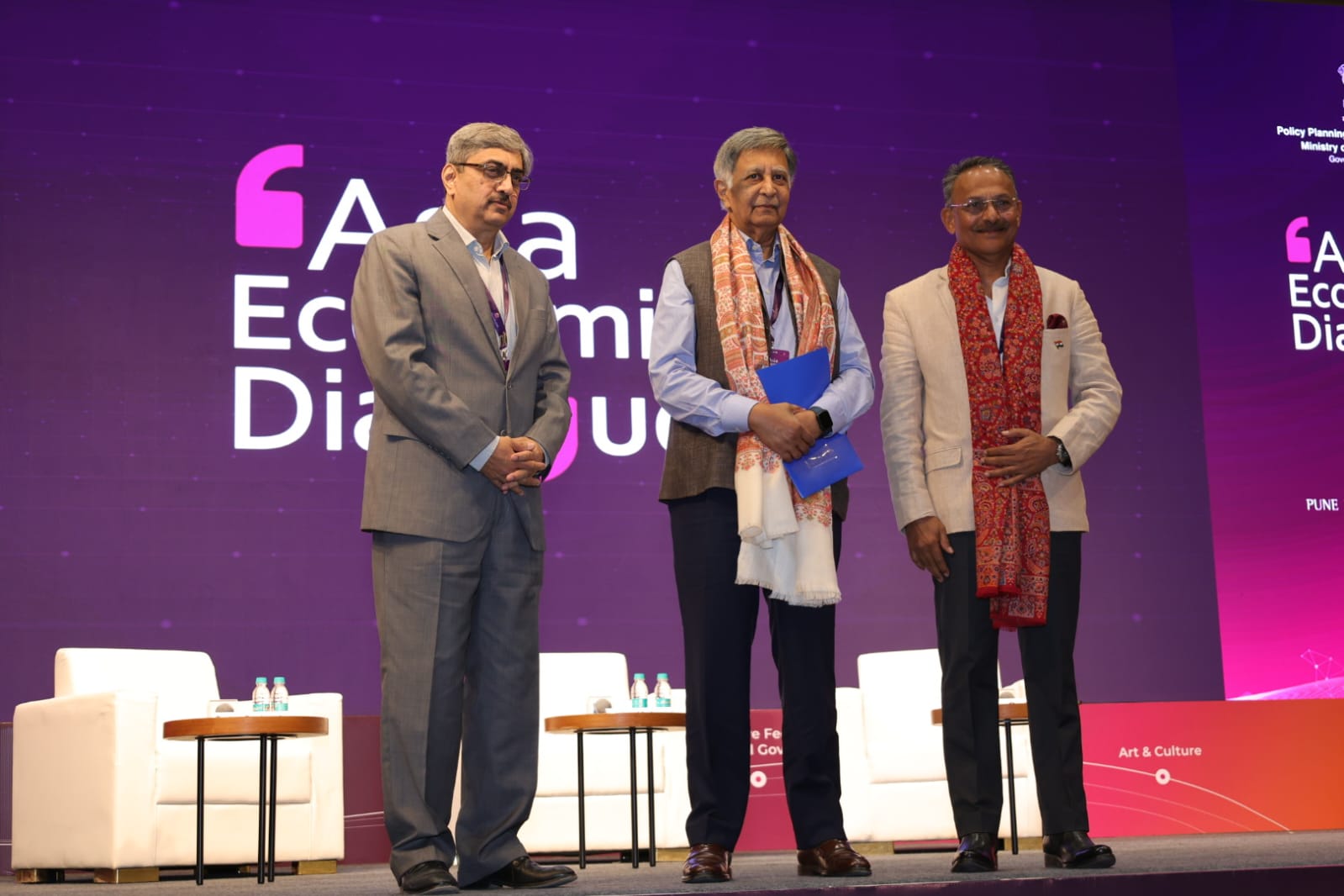
Manufacturing poised for big growth in next 3-4 years: Baba Kalyani
Pune (Voice news service):- The second session of day 2 at Asia Economic Dialogue 2026 featured a compelling Fireside Chat with Baba Kalyani, Chairman and Managing Director of Bharat Forge Limited, in conversation with Amb. (retd.) Gautam Bambawale, Convenor of AED, and Maj Gen (retd.) Nitin Gadkari, former Director of Pune International Centre.

Themed ‘Geoeconomics Beyond Globalisation: Tariffs, Technologies and Strategic Alignments,’ this is the 7th edition of the AED jointly organised by the MEA and PIC. The 3-day, 12-session international conference brings together more than 45 speakers, including academicians, policymakers, and industry experts from nine countries—India, Bhutan, Sri Lanka, Taiwan, Singapore, Kenya, Australia, Israel, and Norway, facilitating an exchange of transformative ideas and strategies.At the Inaugural on Day 1, External Affairs Minister S. Jaishankar in a video message underscored AI, semiconductors, data and critical minerals as new instruments of national power, while Dr. R.A. Mashelkar described the Dialogue as a platform to help shape the emerging world order.
Placing India’s industrial journey in historical perspective, Kalyani traced reforms from the 1991 liberalisation to the structural push under Make in India. India, he asserted, stands at a “true inflection point,” with manufacturing poised for unprecedented growth over the next three to four years.
Reflecting on Bharat Forge’s entry into defence, Kalyani described it as a personal conviction rooted in his military school background. “If we could forge the metal, we could forge India’s defence independence,” he said, recounting how the company built and tested its first artillery gun abroad due to procedural hurdles at home, adding that processes have improved.
Kalyani underscored the critical role of Defence Research and Development Organisation (DRDO), calling it “one of the most outstanding defence research organisations,” and emphasised that meaningful progress began when industry and DRDO collaborated.
Looking ahead, he stressed that raising manufacturing from 15.5% to 25% of GDP by 2047—a tenfold expansion—would require deep investment in R&D and indigenous technology. “If you want to be a sovereign nation, you better create your own technology and your own IP,” he said, warning that without building domestic AI models and compute infrastructure, India risks remaining a bystander in the next technological revolution.
Expressing confidence in India’s long-term trajectory, Kalyani said he was certain that if not this generation, “the next generation will make it happen,” underscoring his belief that technological sovereignty and defence self-reliance are now embedded in the nation’s DNA—but it will demand sustained reform, research and relentless hard work to realise the vision.

Comments are closed.