
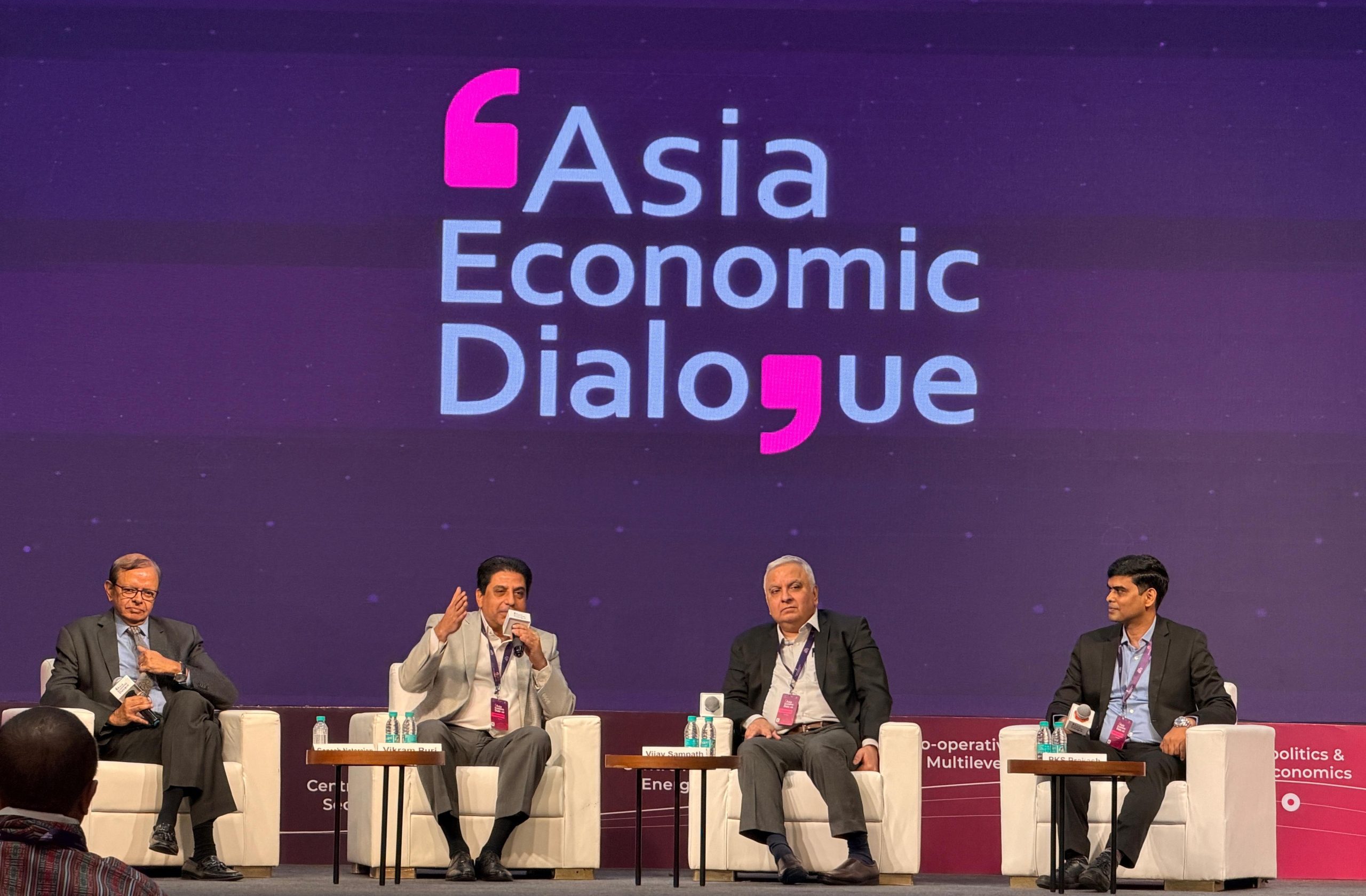
Experts at AED 2026 call for sovereign, human-centred AI beyond fear and hype
Pune (Voice news service):- The Asia Economic Dialogue 2025, the annual geoeconomics conference organised jointly by the Ministry of External Affairs (MEA) and Pune International Centre (PIC), kicked off in Pune on Thursday, February 26, 2026.

Themed ‘Geoeconomics Beyond Globalisation: Tariffs, Technologies and Strategic Alignments,’ this is the 7th edition of the AED jointly organised by the MEA and PIC. The 3-day, 12-session international conference brings together more than 45 speakers, including academicians, policymakers, and industry experts from nine countries—India, Bhutan, Sri Lanka, Taiwan, Singapore, Kenya, Australia, Israel, and Norway, facilitating an exchange of transformative ideas and strategies.
At the Inaugural on Day 1, External Affairs Minister S. Jaishankar underscored AI, semiconductors, data and critical minerals as new instruments of national power, while Dr. R.A. Mashelkar described the Dialogue as a platform to help shape the emerging world order.
Day 2 of the Dialogue began with an engaging Panel Discussion on Dual Intelligence, chaired by Dr. Ganesh Natarajan, Chairman, 5F World; and featuring panellists Vikram Puri, President and CEO, POSHS Group; Vijay Sampath, Founder and CEO, LA-PRO; and Dr. PKS Prakash, Partner, ZS Associates, Lead, ZS AI Innovation Lab.
Dr. Natarajan observed that “the narrative around AI swings between magic and panic,” cautioning against both hype and alarmism. “Innovation does not simply erase the past; it builds on it,” he said, underlining that legacy institutions can adapt and integrate new technologies intelligently.
Describing AI as “the great equaliser,” Vikram Puri stressed that “sovereignty in technology is not a slogan — it is a necessity.” He argued that geopolitical barriers increasingly “shape code,” and urged India to embrace AI as a force multiplier. “Guardrails are necessary. But innovation cannot grow inside fear,” he remarked, adding that AI must be viewed “less as an enemy and more as a tool.”
Vijay Sampath highlighted the concept of bounded rationality, noting that “human decision-making is constrained by time, information and cognitive limits.” Responsibly designed AI, he said, can expand these boundaries without replacing the human mind, and India must build solutions rooted in its own workforce realities.
Dr. Prakash underscored the shift in AI’s evolution: “We’ve moved from asking machines to predict the future to asking them to decide it.” As coding becomes cheaper, he noted, “accountability becomes expensive.” Emphasising “humans in the loop,” he concluded that AI amplifies expertise and will expand — not eliminate — opportunity.

Comments are closed.