
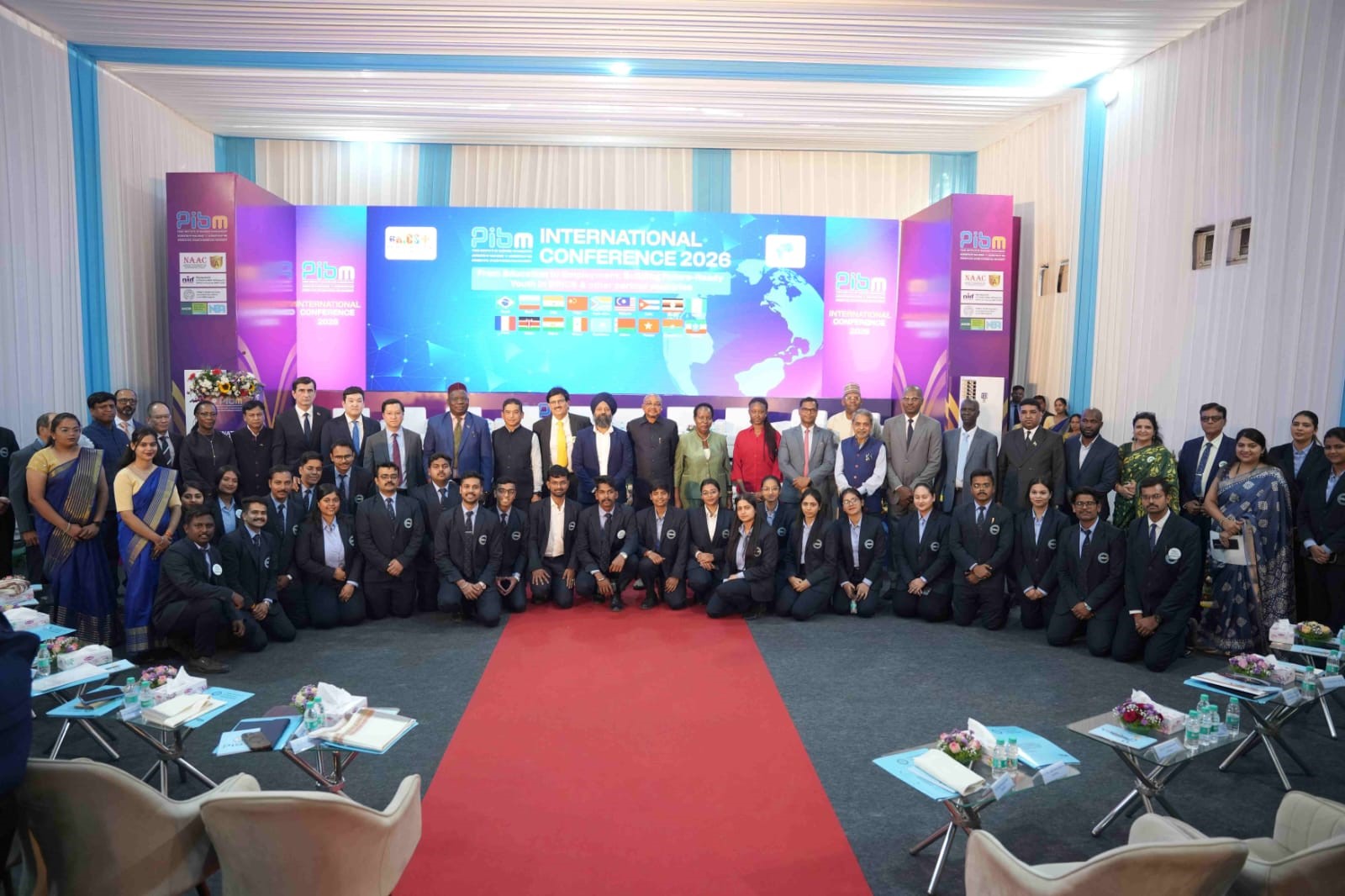
PIBM Hosts International Conference 2026 on Building Future-Ready Youth Across BRICS and Partner Countries

Pune (Voice news service):-The Pune Institute of Business Management (PIBM) hosted the “International Conference 2026” themed “From Education to Employment – Building Future-Ready Youth in BRICS & Other Partner Countries,” bringing together policymakers, diplomats, academicians, and students to discuss strategies for preparing young talent for the evolving global workforce.
The conference focused on the urgent need to bridge the gap between education and employment through skill development, technological awareness, and international collaboration. Representatives from multiple countries across Asia, Africa, Europe, and Latin America participated in the event, highlighting the growing importance of cross-border partnerships in shaping a skilled and future-ready workforce.
Addressing the gathering, Dr. Vinodkumar Gaikwad, Regional Passport Officer in Pune, emphasised the importance of preparing youth for a rapidly changing world. He noted that India today possesses one of the largest pools of young talent globally. With appropriate education, skill training, and exposure, this talent can contribute significantly not only to India’s growth but also to the global economy.
Dr. Gaikwad highlighted the Prime Minister’s emphasis on skill development as a critical factor shaping the future workforce, particularly as emerging technologies such as artificial intelligence transform industries worldwide. He stressed that education systems must increasingly focus on innovation, technological literacy, entrepreneurship, and adaptability so that young people are prepared for emerging industries and global opportunities.
Dr Gaikwad also highlighted India’s contribution to global capacity building through the Indian Technical and Economic Cooperation Programme (ITEC), an initiative through which India provides training and skill development opportunities to thousands of professionals and young leaders from partner countries every year. Through scholarship and cooperation programmes, India also welcomes thousands of students from countries of the Global South to pursue higher education at Indian universities.
Speaking about Pune’s role as a global education hub, Dr. Gaikwad noted that the city hosts more than 100,000 students from across India and several countries around the world. “These initiatives promote knowledge sharing, skill development, and stronger people-to-people ties, reflecting India’s commitment to shared growth and capacity building,” he said.
He also emphasised the importance of international mobility and global exposure for young people in an increasingly interconnected world. “In my capacity as the Regional Passport Officer in Pune, I often see how education connects young people to the wider world. For many Indians, passports are not merely travel documents but gateways to global learning, innovation, and professional opportunities,” he said.
PIBM Chairman Ramanpreet Calls for Global Collaboration in Skill Development
In his keynote address, Ramanpreet Chairman of the PIBM Group of Institutes, welcomed ambassadors, diplomats, and senior professionals from various countries.
“The purpose of this conference is very simple. After conducting extensive research, we realized that the world must come together to address a crucial challenge – developing skills and competencies among the youth,” he said. He noted that the core agenda of the conference was to discuss one of the most pressing global priorities – building competencies among youth to meet future workforce demands.
Sharing insights from research conducted by PIBM, he explained that small and medium enterprises (SMEs) and mid-sized companies contribute nearly 30–40% of GDP in most developing economies, whereas in developed nations their contribution often exceeds 50–55%.
According to Ramanpreet, one key reason for this gap is the level of workforce skill development. “In developed economies, the working population has been consistently trained and skilled for the future – often preparing for the needs of the next five to ten years,” he explained. He further noted that global industries are evolving at a rapid pace, requiring billions of people to continuously upgrade their skills.
Another significant insight highlighted during the PIBM conference was related to global talent selection patterns.
Ramanpreet explained that roughly 5% of the global population qualifies through advanced assessments such as analytical, quantitative, and verbal ability tests and eventually enters top global organisations.
However, the remaining 95% of the workforce contributes to small, medium, and large enterprises worldwide, making them an essential pillar of economic growth.
He referred to reports from the World Bank suggesting that 60–70% of the global workforce will be employed in SMEs and mid-sized companies.
“If we do not focus today on developing competencies for this large segment of the youth population, it will directly impact GDP growth in many countries,” he said.
Proposal for Global Business Centres of Excellence
As part of the discussions at the PIBM conference, Ramanpreet proposed the creation of sector-specific Business Centres of Excellence through international collaboration.
Inspired by India’s sector skill council model, these centres would focus on specific industries and help develop best practices, advanced business solutions, and innovation-driven products and services.
“Different countries have strengths in different sectors. Some excel in manufacturing, while others are leaders in technology or services,” Singh said.
Through collaboration, countries could share best technologies, processes, and business models to create better solutions for consumers globally. He emphasised that such partnerships could also enable SMEs to adopt modern technologies and automation more effectively. He added that such initiatives would directly benefit the 95% of youth who may not always enter top-tier corporate pipelines but form the backbone of the global workforce. By equipping them with globally relevant skills, countries could improve employability, productivity, and innovation.
Strengthening Values Alongside Skills
Beyond skills and technology, the PIBM chairman also highlighted the importance of strong value systems in shaping responsible leaders.
“A strong value system shapes both individuals and nations. When education, skills, and collaboration are guided by the right values, the outcomes become more sustainable and impactful,” he said.
He emphasised that governments, institutions, and industries must work together to nurture ethical leadership alongside technical competencies. Such efforts, he concluded, would help create a future-ready generation capable of driving innovation, economic growth, and global cooperation.
The PIBM International Conference 2026 concluded with a call for stronger collaboration between nations, institutions, and industries to prepare youth for the evolving global economy and build a sustainable pathway from education to employment.

Comments are closed.