
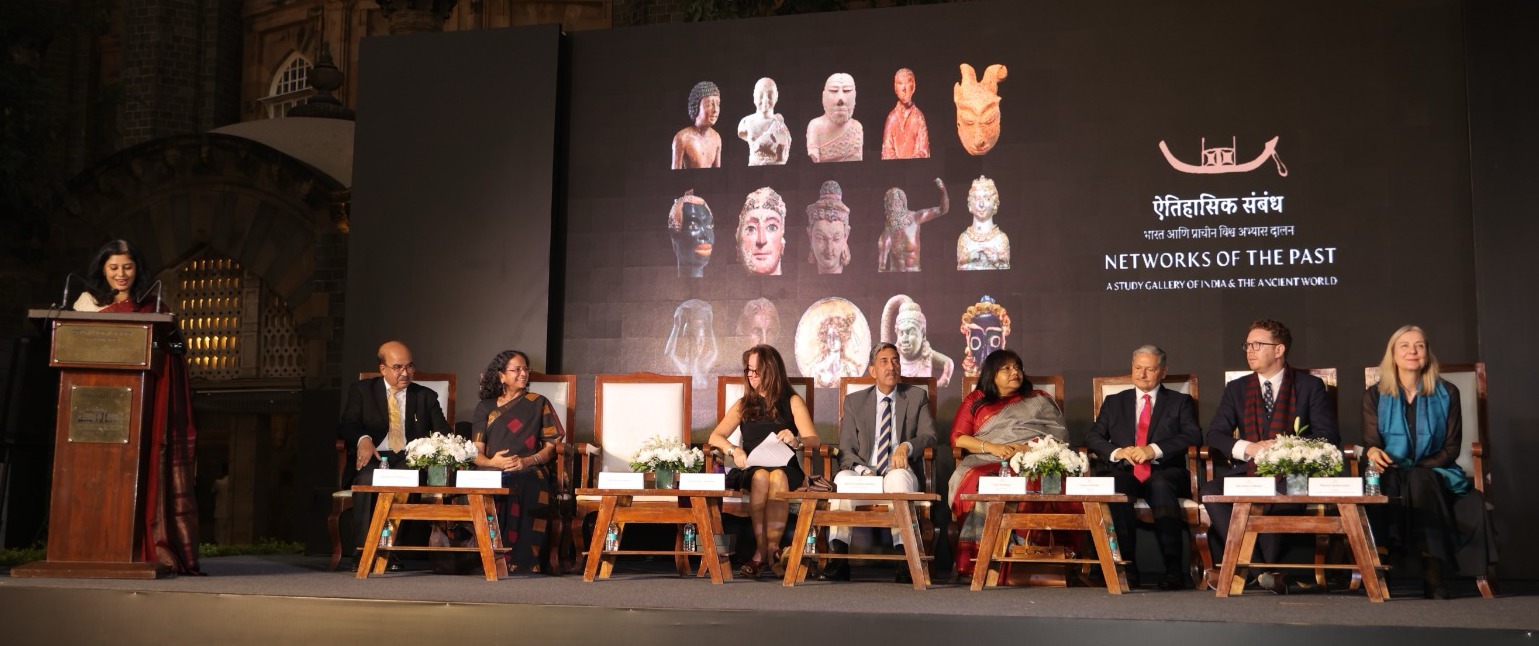
Chhatrapati Shivaji Maharaj Vastu Sangrahalaya (CSMVS) unveiled ‘Networks of the Past: A Study Gallery of India and the Ancient World’ in Mumbai
Pune (Voice news service):- When Networks of the Past: A Study Gallery of India and the Ancient World opened at the Chhatrapati Shivaji Maharaj Vastu Sangrahalaya (CSMVS) in December 2025, it added a new dimension to India's cultural landscape. It shows how the ancient world was interconnected through trade, writing, religion, art, and ideas 5000 years ago.

Four years in the making, Networks of the Past brings together 300 original archaeological objects on long-term loan from 15 Indian and leading global museums. These tell stories from the ancient cultures of India, Egypt, Mesopotamia, Greece, Rome, Persia, and China, alongside treasures from undivided India, including the oldest Harappan (Sindhu-Sarasvati) Civilisation. A detailed model of Dholavira anchors the narrative, showing how early Indian cities were designed, governed and sustained within wider regional networks.
For audiences across India, the gallery includes sculptures, inscriptions, edicts, coins, paintings, objects from ancient burial sites, jewellery, miniature models from tombs, global pottery, and portraits with their replicas. These form the core of the display, establishing a rich resource of primary historical material for study and enjoyment.
Seen together, these objects reveal a world that was deeply interconnected more than 5,000 years ago, linked by trade, technology, belief systems, artistic practices and centres of learning.
Networks of the Past is a study gallery designed to support an educational programme based on objects as material evidence of history. The CSMVS Education Department developed it through partnerships with academic and cultural institutions in Mumbai and across the country. In collaboration with the Cambridge University Global Humanities Programme and over 20 Indian universities, the gallery supports object-based learning through lectures, workshops, research and digital resources.
Dr. Sabyasachi Mukherjee, Director General, CSMVS, said, “Civilisation is not a destination – it’s a journey. The gallery invites us to explore the ancient world not as something lost to history, but as the foundation upon which our present stands and our future is built. The past has profoundly shaped global, national, and local relationships between societies and individuals. The events, innovations, and decisions made in antiquity continue to influence our world today. In today’s interconnected world, no major event goes without impacting humanity. To understand our history meaningfully, we must move beyond isolated narratives and adopt a global perspective.”
Getty’s Sharing Collections Programme supports this initiative and is the result of international collaboration between CSMVS and its longstanding partner, The British Museum, London. It is also joined by Staatliche Museen zu Berlin, Museum Rietberg, Zurich, and for the first time, the Benaki Museum, Athens, the Al-Sabah Collection, Kuwait, and the Ephorate of Antiquities of the City of Athens.
The project is endorsed by the Ministry of Culture, Government of India and features important antiquities from the rich collections of the Archaeological Survey of India, the National Museum, New Delhi; Allahabad Museum, Prayagraj; the Department of Archaeology and Museums, Government of Maharashtra; the Indian Museum, Kolkata; the Bihar Museum, Patna; the Government Museum, Mathura and the State Museum, Lucknow.
With the Union Budget 2026 announcing focused development of 15 archaeological sites across the country, the gallery shifts focus from seeing history only through monuments to understanding civilisation as connected and lived. Meaning comes not just from excavation, but from how objects are interpreted, compared and shared with the public.

Comments are closed.